ChandlerWobble
The Chandler wobble as a synchronized rotational mode: a supplementary view
This directory is a supplementary view of the Chandler wobble (CW) model in this repository. It reads the model
(../cw_physics.py, ../cw.py) the way the QBO and ENSO were read as toroidal plasma devices in
gem-lte-core/docs. This time the reference is rotating electromagnetic machinery and control theory:
- Synchronization is ordinary. A rotational mode whose phase is set by an external cyclic torque is routine in rotating machines.
- The Earth’s idiosyncrasy. The lunar torque reaches the wobble only during impulsive, twice-yearly changes in the moment of inertia. That pulse comb samples the fortnightly torque, and the CW sits at the alias |2 × draconic − 26| = 0.8440 /yr. The Moon’s distance cycle gives a second line, Mm, at 14 − anomalistic = 0.7448 /yr.
- Evidence from raw IERS polar motion (1973–2026). Both lines are phase-locked: the joint chance under a noise-driven free wobble is 0.1–0.5%. Every comb line emerges at about its observed strength through a modest-Q bandpass (Q ≳ 30). The consensus Q ≈ 85+ was needed only to keep a free wobble ringing.
- The control-theory check. The counter-torque that would remove the wobble is 10⁻⁴–10⁻³ of the lunar torque on the bulge. A pulsed controller that removes it ends up firing the aliased lunar pulse train, reversed.
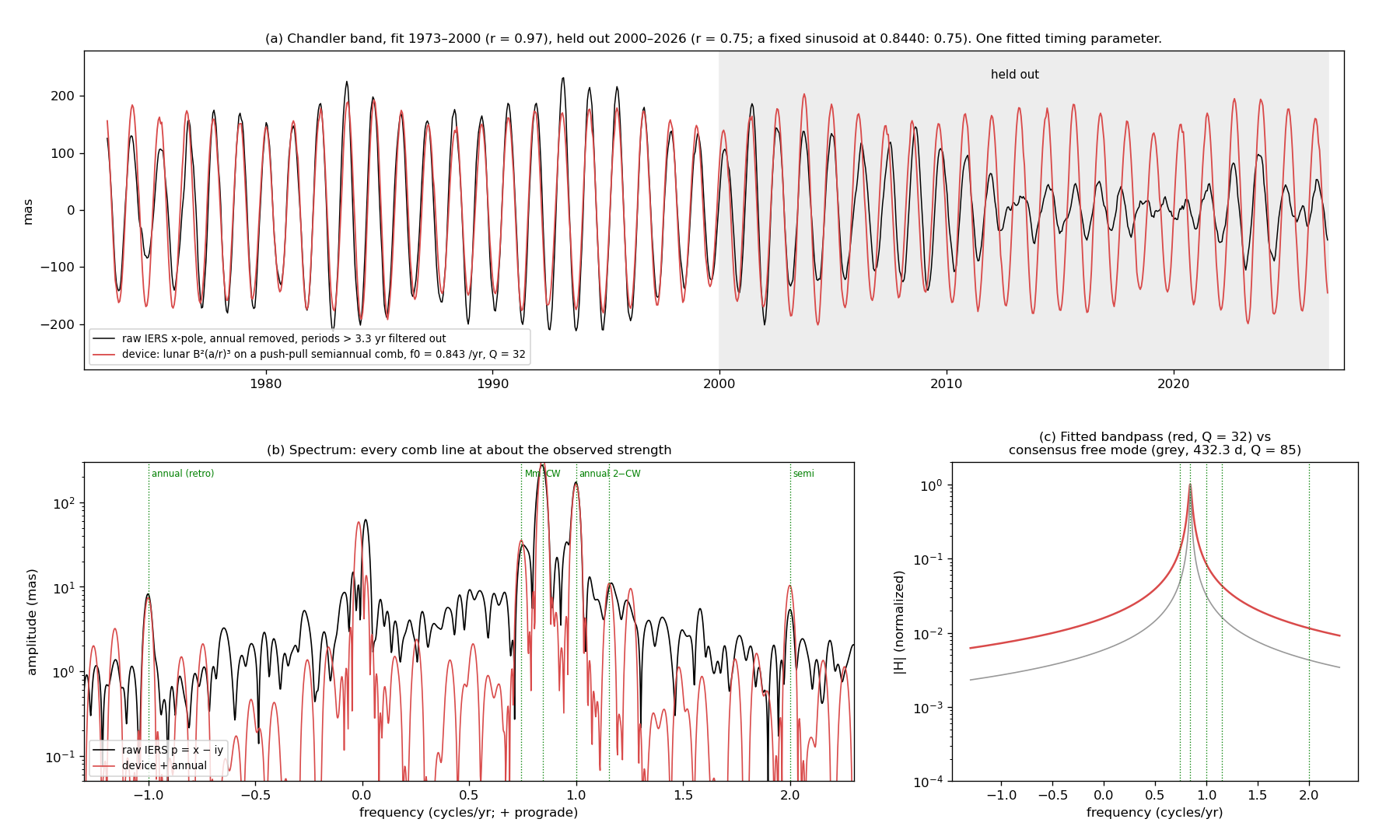
The essential fit (cw_flagship.py), on raw IERS polar motion.
- The device: the astronomical lunar torque (ecliptic latitude squared × (a/r)³), gated by push-pull seasonal inertia pulses about 5.5 days wide, through one prograde mode with f₀ = 0.843 /yr and Q = 32.
- One timing parameter is fitted on 1973–2000. Held out to 2026, the Chandler band correlates at r = 0.75, the same as a fixed sinusoid: the time domain does not discriminate.
- The evidence is the line set (panel b: CW, Mm, annual, semiannual and 2 − CW at about their observed strengths) and the phase locks.
Documents
| document | what it covers |
|---|---|
| cw_synchronized_wobble.md | The lead. Synchronization in rotating machinery; the pulsed inertia comb and aliasing; the bandpass fitted without consensus constraints; the phase-lock evidence; the counter-torque and a pulsed controller; what would strengthen or break the case. |
| cw_data_tests.md | The data. Raw IERS against cw.dat. The cw.dat 1 ∓ CW side peaks are cross-terms of a seasonal gain in its processing. Every peak catalogued; phase stability of each candidate line (CW, Mm, the 0.817 feature, the other labelled lines); the joint chance; and a log of the claims these tests withdrew. |
| cw_suppression.md | Supplement. The post-2010 collapse of the CW (cf. Yamaguchi & Furuya 2024): too fast for free decay at any Q the line set allows; the required forcing reverses in 2010–16, goes quiet, then resumes; the counter-torque needed is the same few × 10⁻⁴ of the lunar torque. Candidate mechanisms: a ~1-week shift in the seasonal comb (which would also rotate Mm and the QBO alias, linking the QBO disruptions the paper cites), a steady F − M beat (~93 yr: 1920s and 2015–20 minima), and a 2F + M counter-modulation that needs an annual impulse. F − M is the Earth’s 6-year cycle (Cazenave et al. 2025) and ≈ 1/6 /yr, a reliable assist every sixth year. Its ~93-yr beat with the CW places the 1920s reversal (Malkin & Miller 2010) out of sample and the present absence; its 7/6 /yr alias is steady in raw polar motion. (In raw LOD the 6-year cycle is not separable from red noise.) |
| cw_longrecord.md | Supplement. Long-record phase coherence, IERS C01 1846–2026: the CW phase is locked to the draconic alias for 70 years (1939–2008, ±14.5°) and 40 years before the 1920s, the two plateaus 175° apart. A noise-driven free mode reproduces that pattern in ≤ 0.1% of runs. The F − M beat fitted after 1973 places the 1920s minimum at 1926.7 (observed 1926.3). |
| cw_magnetized_spheroid.md | The device appendix. The Euler ↔ Landau–Lifshitz identity for the free mode; the first device (sharp kicks, 432 d, Q = 85); the alias table shared with the QBO; first fits against cw.dat; laboratory analogs. |
| ../README.md | The core impulse model and its spectral estimators. |
| ../ChandlerWobbleForcing.pdf, ../dialog.pdf | The 2021 satellite-peak post (based on a processed series; see data tests §2) and the alias derivation. |
~/eval/gem-lte-core/docs/qbo_tokamak.md |
The companion QBO device: the same comb and draconic alias, with the sign kept. |
Selected figures
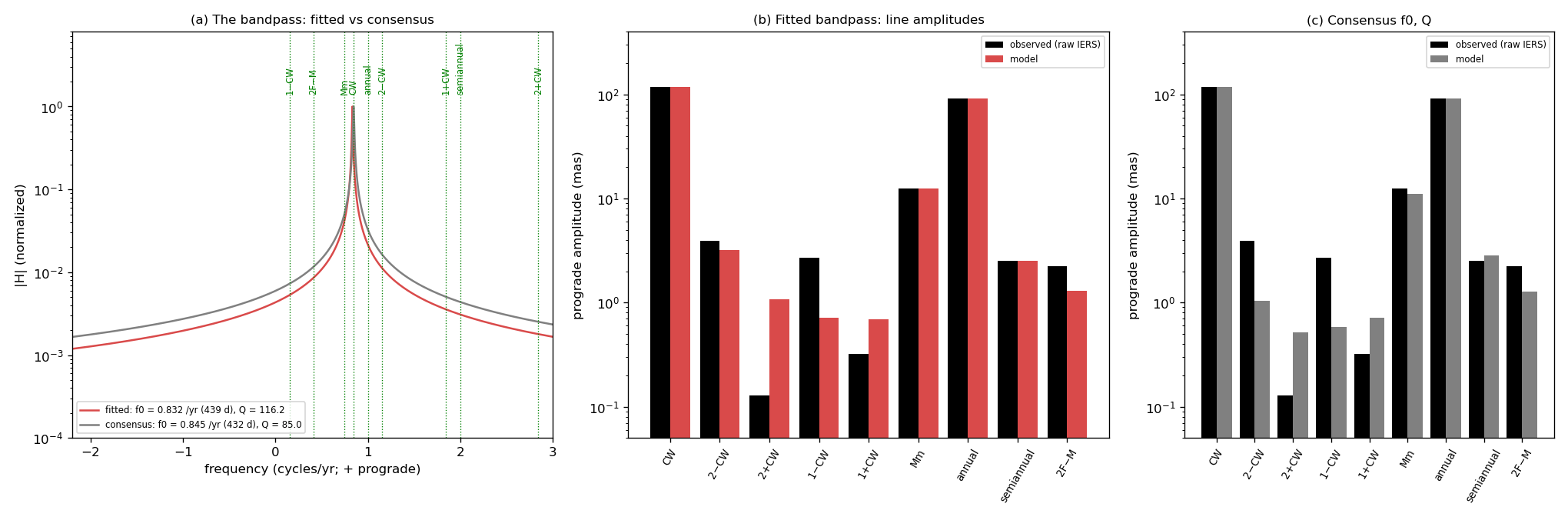
The bandpass without consensus constraints (cw_bandpass.py). f₀, Q, pulse shape and asymmetry are free; the annual
has its own excitation. The 2 − CW line sets Q ≳ 30, and f₀ lands at 425–440 d.
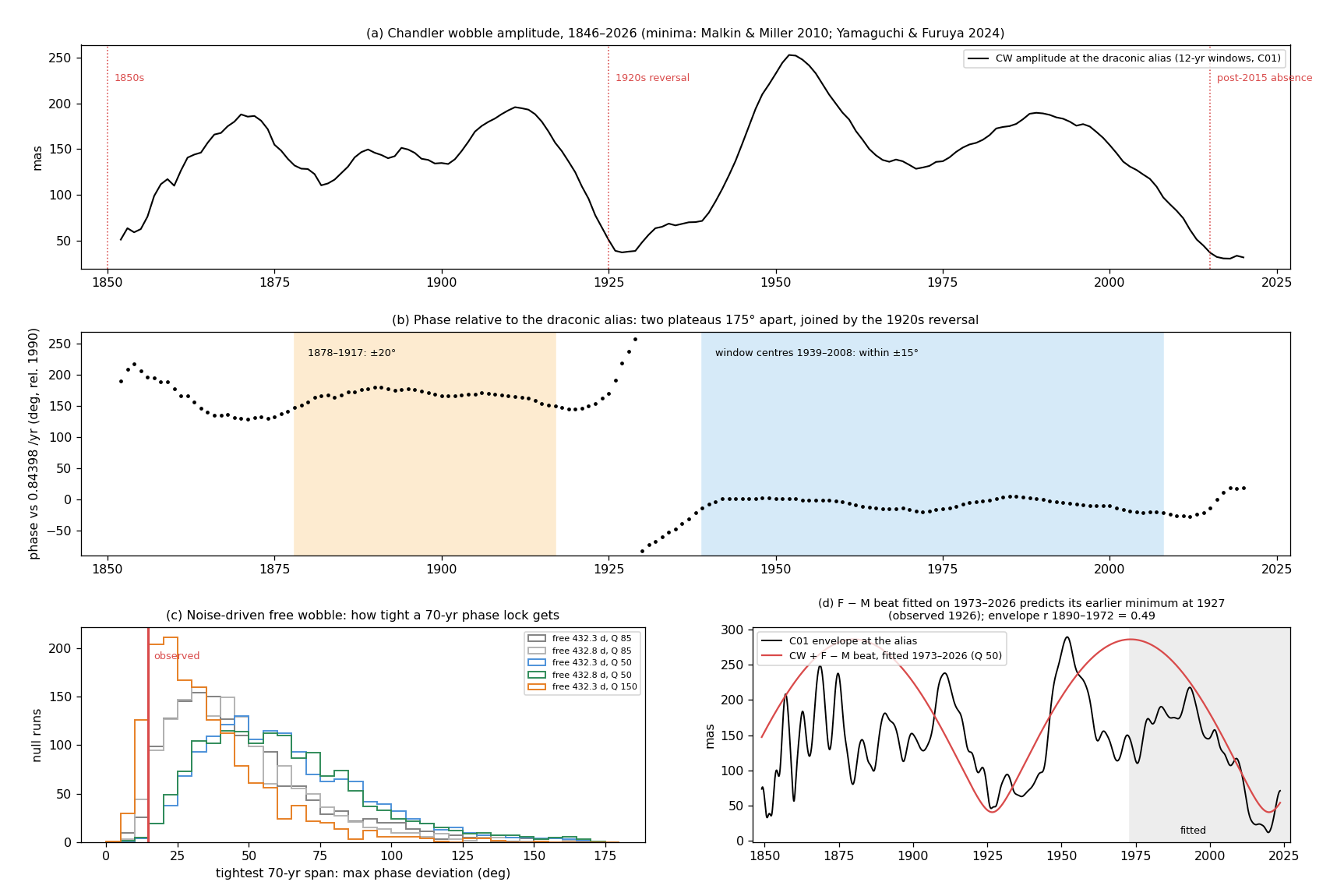
Long-record phase coherence (cw_longrecord.py, IERS C01 1846–2026). Relative to the draconic alias, the CW phase
sits on two plateaus, 1878–1917 and 1939–2008, joined by the 1920s reversal at the amplitude minimum. The F − M
beat fitted on 1973–2026 alone puts the earlier minimum at 1926.7, against 1926.3 observed.
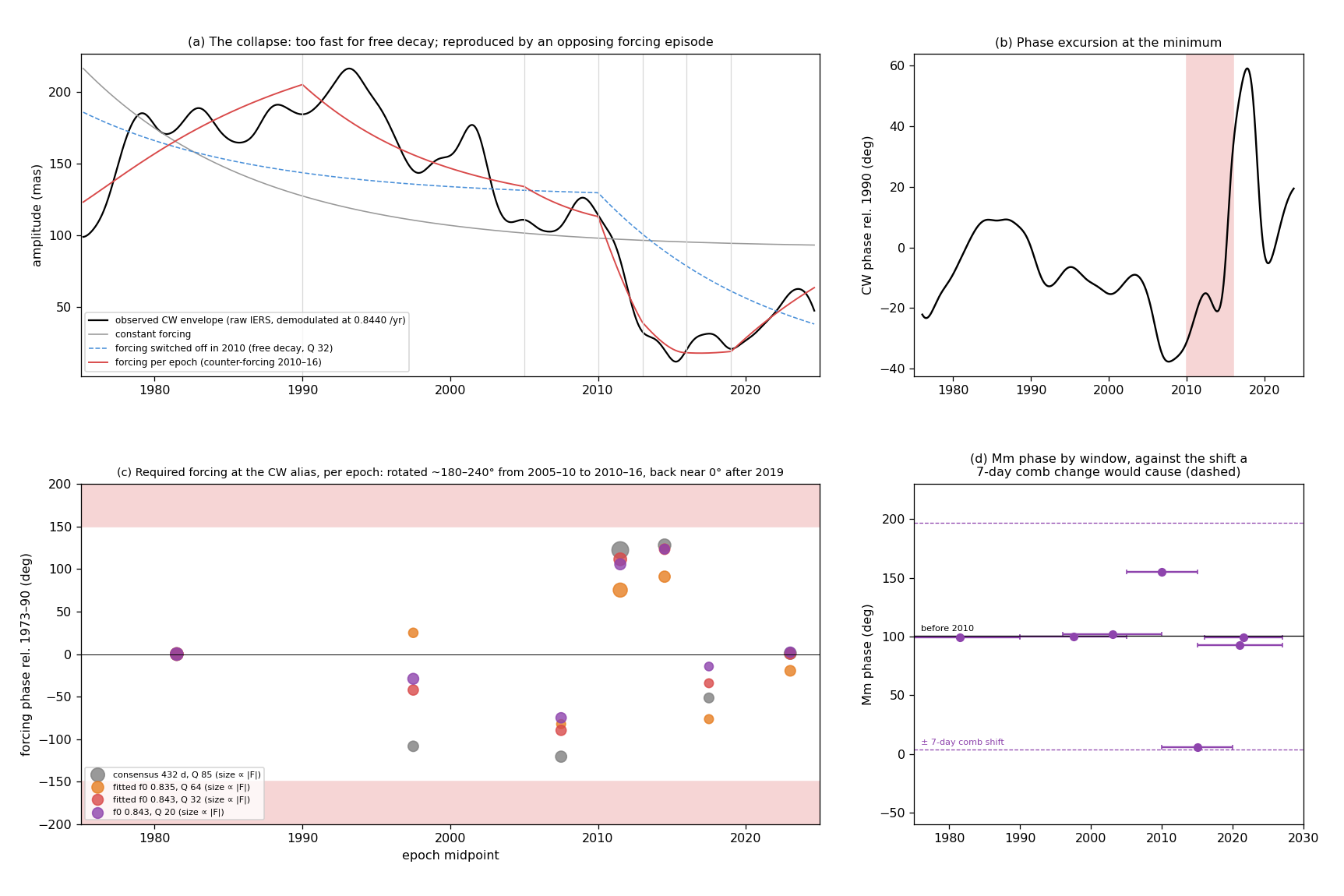
The post-2010 collapse (cw_suppression.py). The CW fell from 112 to 25 mas in 2010–14, an e-fold of 2.6 yr, which
as free decay would need Q ≈ 7. A forcing that reverses in 2010–16, goes quiet, then resumes reproduces the envelope.
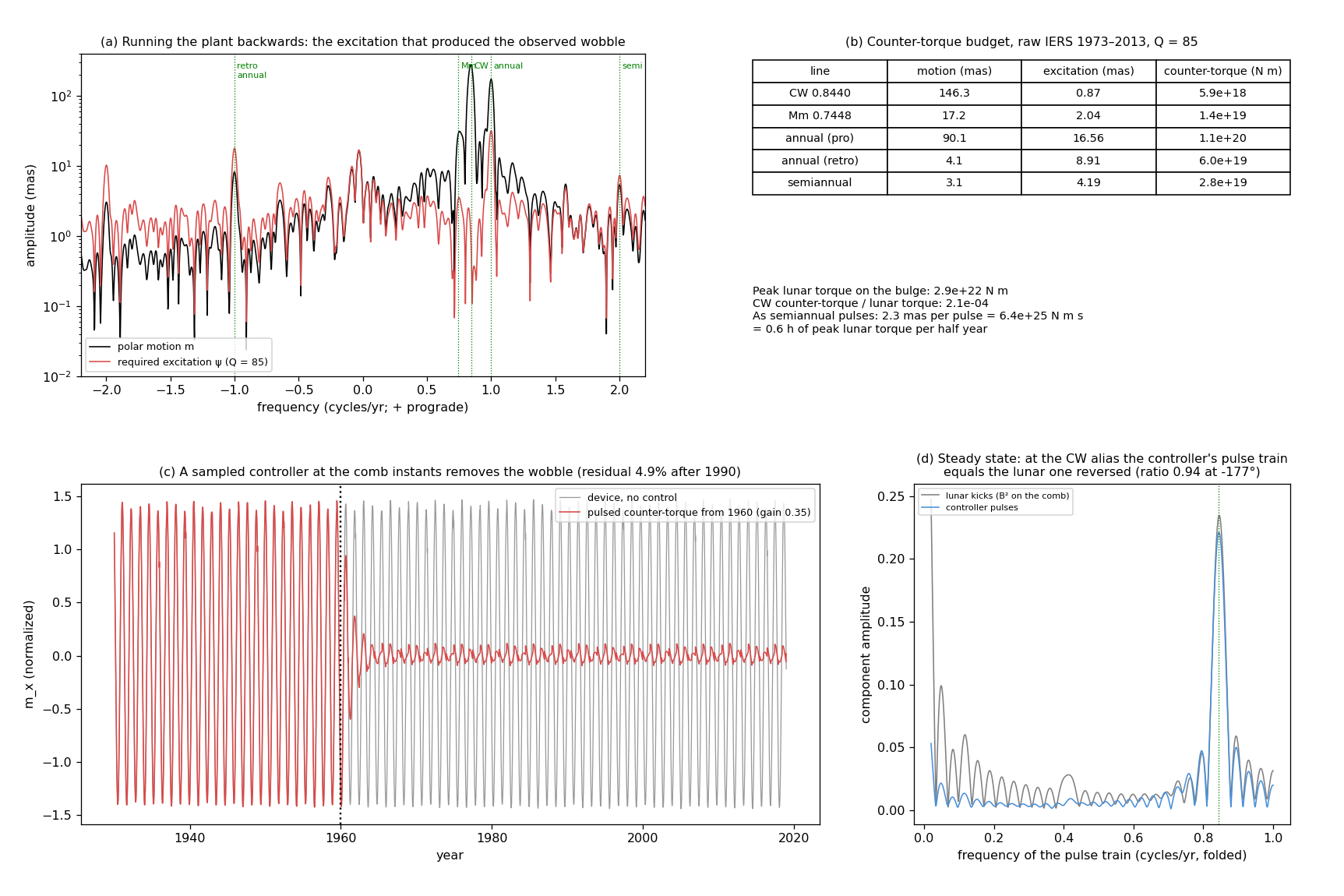
Control theory (cw_counter_torque.py). Running the plant backwards gives the counter-torque that would remove the
wobble. A sampled controller at the comb instants removes the device’s wobble, and its steady pulse train at the CW
alias is the lunar one reversed (0.94 at −177°).
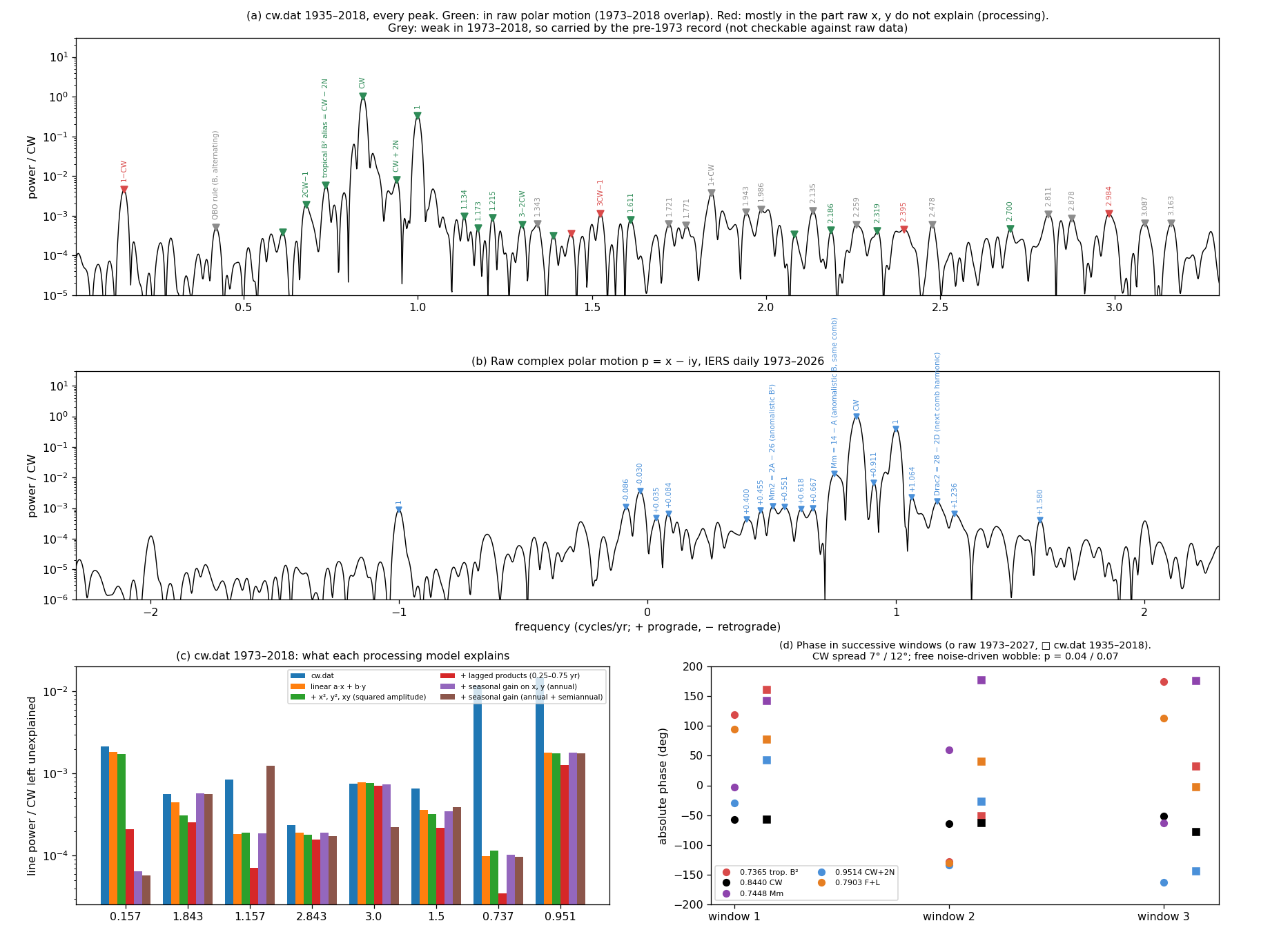
Every peak (cw_peaks.py). Each cw.dat peak is classed as Earth, processing or pre-1973 only. The processing
models are compared, and the absolute phase of the candidate lines is tracked window by window.
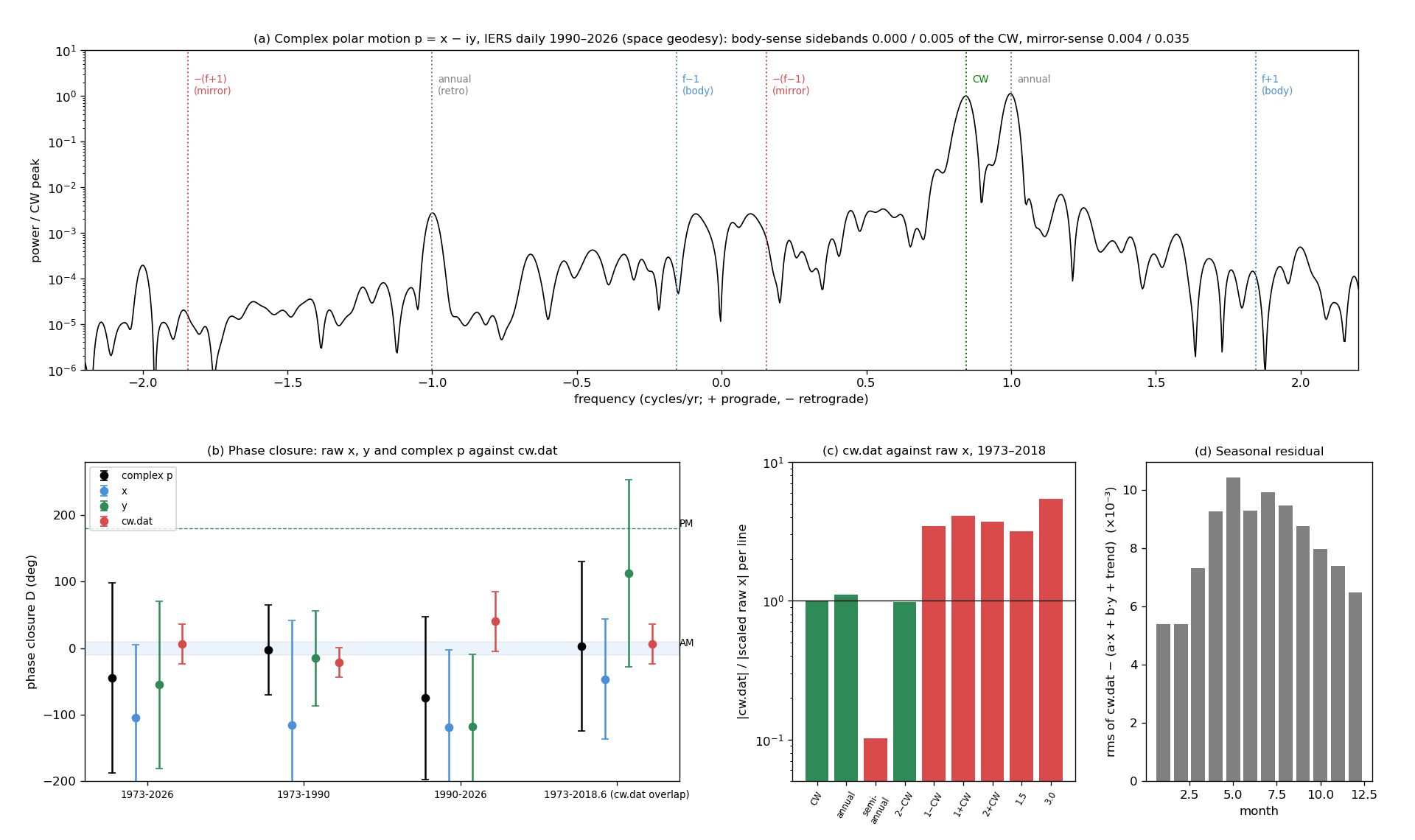
Raw polar motion against cw.dat (cw_eop_closure.py). The upper side peak at 1.843 /yr is absent from raw data;
cw.dat carries 3–5× too much at 1 ∓ CW and has a seasonally varying residual.
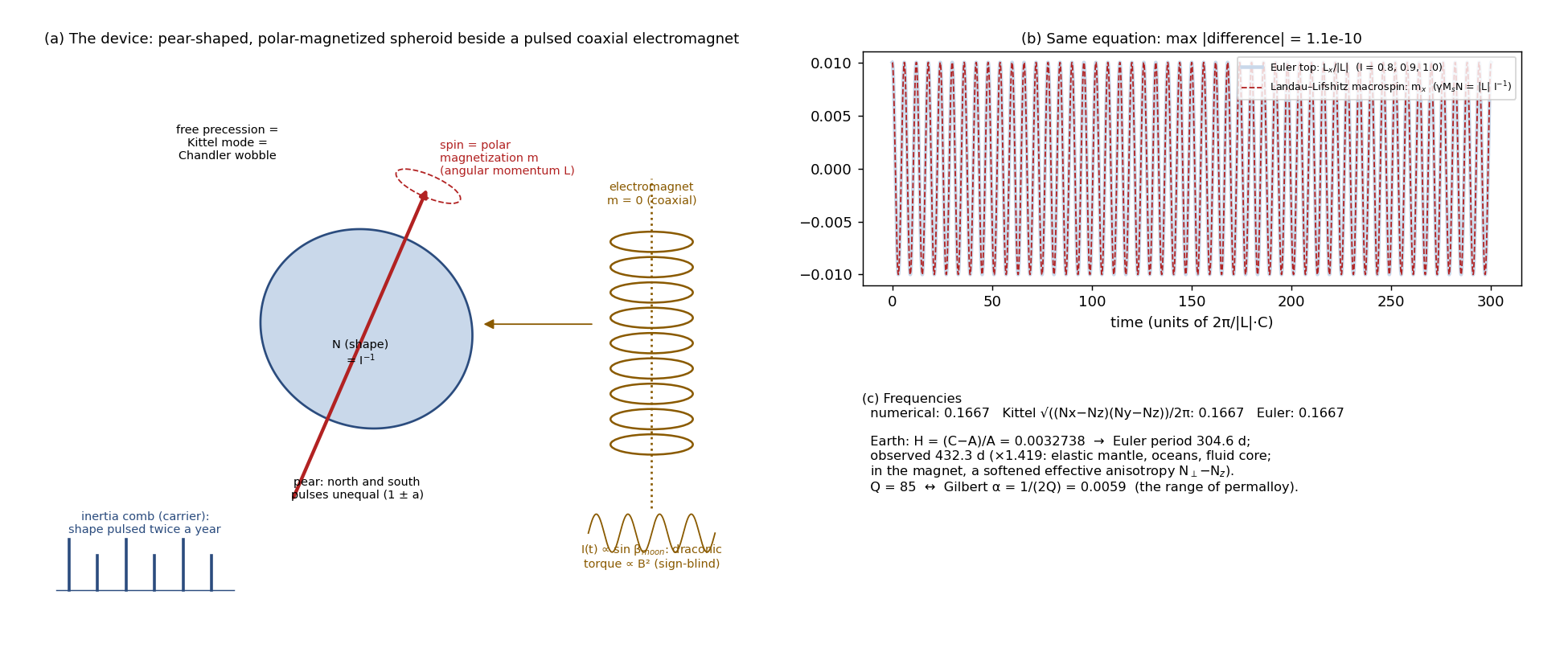
The free-mode identity (cw_magnetized_spheroid.py), kept as mathematics, not as the working analog.
Code and data
- Scripts: each figure and JSON file has a script of the same name, run from this directory. The order:
fetch_eop.py, to download the raw data;cw_magnetized_spheroid.py,cw_sidebands.py,cw_eop_closure.py,cw_peaks.py;cw_bandpass.py, thencw_flagship.pyandcw_counter_torque.py(they readcw_bandpass.json);cw_joint_lock.py,cw_suppression.py,cw_longrecord.py.
- Data:
../cw.dat: a processed x-pole series, 1935–2018.6, of unknown provenance.data/finals2000A.all(IERS Rapid Service daily, 1973–now) anddata/eopc01.iau2000.1846-now(IERS C01, 1846–now), downloaded byfetch_eop.py; not in the repository.
- Lunar elements: computed from Meeus’ mean elements, so lunar phases are astronomical, not fitted. Only numpy, scipy and matplotlib are needed.
These documents are exploratory. Where a result is negative or not yet decisive they say so; the claims withdrawn along the way are listed in cw_data_tests.md §8.